
"Things Multiply": How I discovered a new law of the universe
Or why the explosion of digital stuff is inevitable

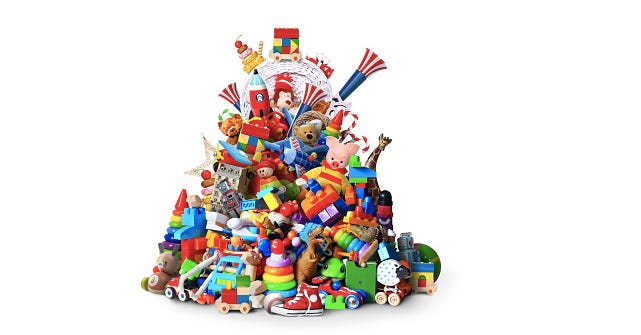
Once upon a time in a simpler halcyon age, it was OK just to be on Facebook. Now you have to be on Facebook, LinkedIn, Instagram, Twitter/X, and BlueSky. You’re supposed to be following TikTok; and have a Discord account and a Slack account. As a professional person, you Must Have a website and a Substack. And now your own podcast.
Digital stuff has a way of compounding as if by some inexorable law. Emails. Photos. Websites. Social media platforms: they proliferate like kudzu, expanding into an infinite virtual space. My email inbox currently contains 20,000 messages. It used to have over 70,000, but a few years ago I set about throwing them out. I start every day – as you likely do – emptying my in-box and shoving most of it into the trash. Nonetheless it amasses.
In the mid-1990’s I wrote a book about concepts of real and virtual space, but what I didn’t realize back then was how unending cyberspace would turn out to be. Because it is limited only by the number of servers on the planet (themselves proliferating at a ferocious rate), cyberspace can be extended ceaselessly so you never run out of room for more digital dross.
It’s not just human fault when stuff proliferates: It’s a basic law of reality that it Will do so.
Physics tells us there are two basic laws of nature: energy tends toward a minimum, and entropy tends toward a maximum. I propose a third fundamental law: Things multiply.
It’s not just digital things. Physical things also multiply to fill the space available. Mammoth piles of books flood the floor of my office. Clothes I haven’t worn in decades crowd out my closets. Every available living room surface bristles with knickknacks. I live in a large house, with my sister, and there’s a bedroom we refer to as “the spare envelope room,” simply because it has no other purpose than to fill up with Stuff. We have a two-car garage chock-a-block with crap.
All this Stuff has been weighing on my mind because we are preparing to put our house on the market and these things must all be dealt with somehow.
I didn’t start out like this. 35 years ago, I moved to Los Angeles from Australia with two suitcases of clothes and six boxes of my most precious memorabilia. My whole life was compacted into eight modest-sized containers. This was after disposing of a houseful of stuff in Sydney. I swore I’d never accumulate again. But here we are three decades later and I have another house-ful to dispense with.
Somewhere along the way, my sister and I concluded that the inflation of shit isn’t just a personal failing. Things multiply of their own volition. It’s not merely human fault when stuff proliferates: It’s a basic law of reality that it will do so.
Think about it. How much time do you spend fighting this tendency? You promise yourself you won’t buy anything you don’t absolutely need. You say that if you do buy something, you’ll get rid of something else. And yet it builds up: Books you don’t read; clothes you don’t wear; knickknacks you thought were groovy in that cute little thrift store but look lame when you get them home.
I predict we are approaching peak Substack and peak podcast, because nobody can be doing all the reading and listening required to keep these all channels alive…
When the internet came along in the 1990’s, I thought it might be an antidote. After all, things don’t exist online, only representations of things. Maybe when we were all wired up, all the time, the explosion of material stuff would cease.
How wrong I was. Not only has the net enabled a massive explosion of shopping, and Amazon enabled an explosion of shipping it to your door (just click “Buy Now”) – more invidiously, digital things have followed the pattern of physical things. They seem propelled by the same innate, inflationary drive.
I predict we are approaching peak Substack and peak podcast, if for no other reason than that nobody can be doing all the reading and listening required to keep these all channels alive, because we must all now be spending our time producing stuff. “Content creator” is the term.
*
It may be that space is infinite, but time is not. As someone with a degree in physics, I’ve long been interested in the distinction between space and time. In physics-school they teach you that, in the end, time is just another dimension of space. That’s what general relativity says.
But this can’t be true. Because whatever ‘time’ is, we have a very finite amount of it. And that thankfully, will limit the expansion of our things. One day you will die – and at that point all Your Stuff will be thrown away. Though given current trends, our digital shit may well live on forever in the infinite expanding spaces made possible by the exponentiating plague of data centers taking over our planet.
*
The book I wrote on concepts of space was The Pearly Gates of Cyberspace: A History of Space from Dante to the Internet (W.W. Norton, 1998).
I’m currently working on a follow-up book about the concept of “dimension” in math, physics, data-science, art and culture. More news on that in my next post.
*
Opening image of “huge pile of stuff” from media.istockphoto.com
I travel light. I got rid of a lot of stuff when 1, got divorced and moved out of my house, 2, moved to Hoboken a few years later. I was lazy, I didn't want to lug stuff with me. Laziness also explains why I have relatively little online presence. I did buy a Christmas tree, but of course I'll be tossing that out soon.
💯
Bullseye-I moved from the USA -> SYD in 1987 with just a garment bag with 5 suits and a duffel bag of clothing
Today I live in an inner city warehouse that is overflowing with cr _ p
Wertheim's Third Law..
;)